Use cases
What problem does this actually solve — end to end?
Runback exists for one moment: the one where you have to reproduce, defend, or stop an agent decision — not admire a dashboard.
The problems Runback exists to solve — at startup stakes and at enterprise stakes, end to end.
See the mechanism behind these →Runback exists for one moment: the one where you have to reproduce, defend, or stop an agent decision — not admire a dashboard.
The missing primitive costs an engineer a bad night: "why did the agent do that at 2 AM" with no way to answer it except staring at logs.
The exact same gap — no re-executable record of what the model saw and decided — becomes an unanswerable question from an auditor, a board, or a court.
Four failure classes show up at every scale. None are visible in a log. All are visible in a replay.
Live demos, not screenshots — we're early enough to show the mechanism rather than dress up a case study we don't have yet.
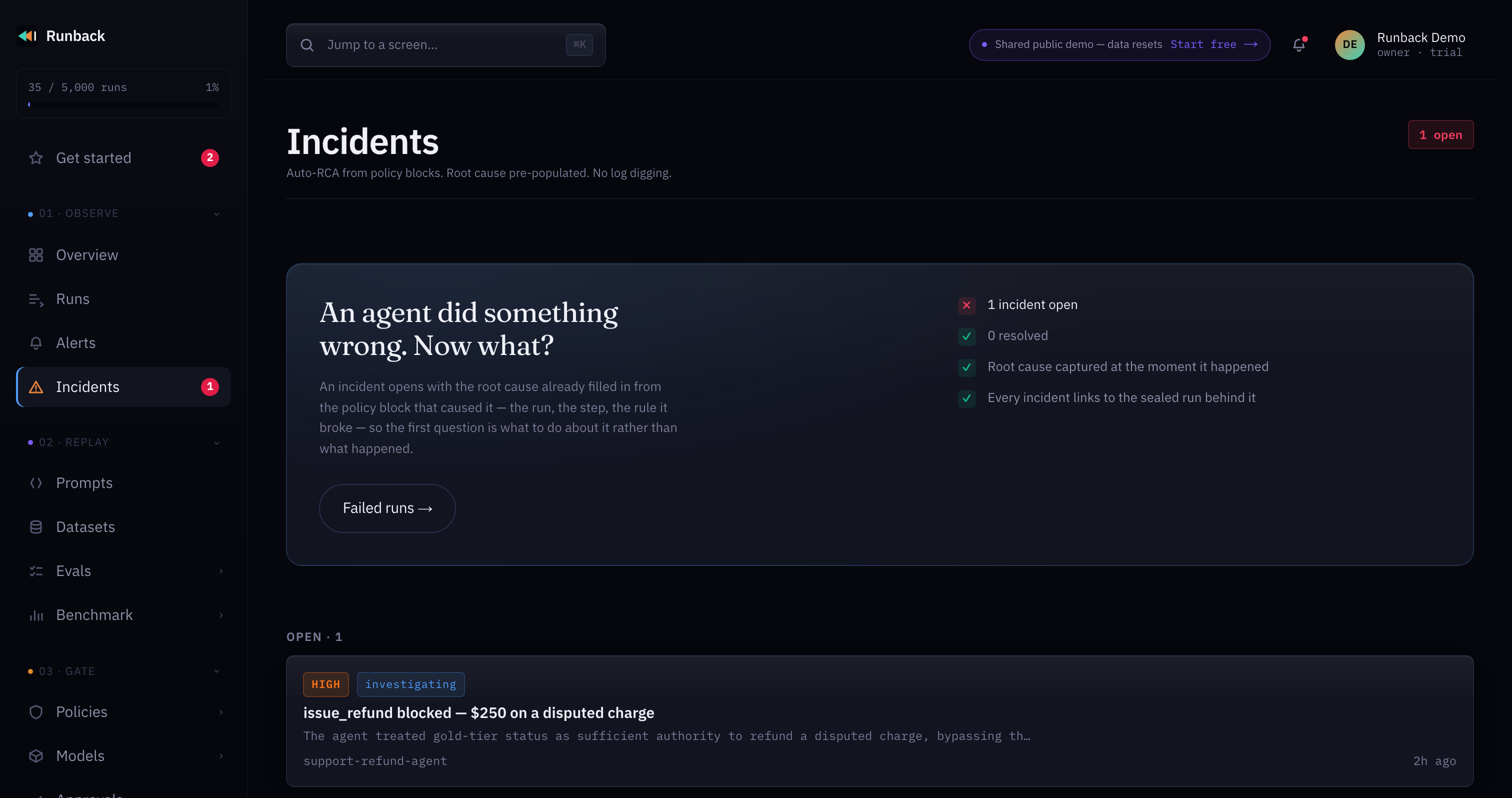
loan-approval-agent auto-approves a loan it should have escalated. The only record is a log line: "approved, 2:47 AM." Below is an illustrative before/after from the incident walkthrough — a worked example, not a customer story. We are too early to have one.
A limit written into the system prompt is advisory, not enforced — the model can decide to break it anyway. Pick the world closest to yours, then click through the run: the gate catches it before the call reaches anyone.
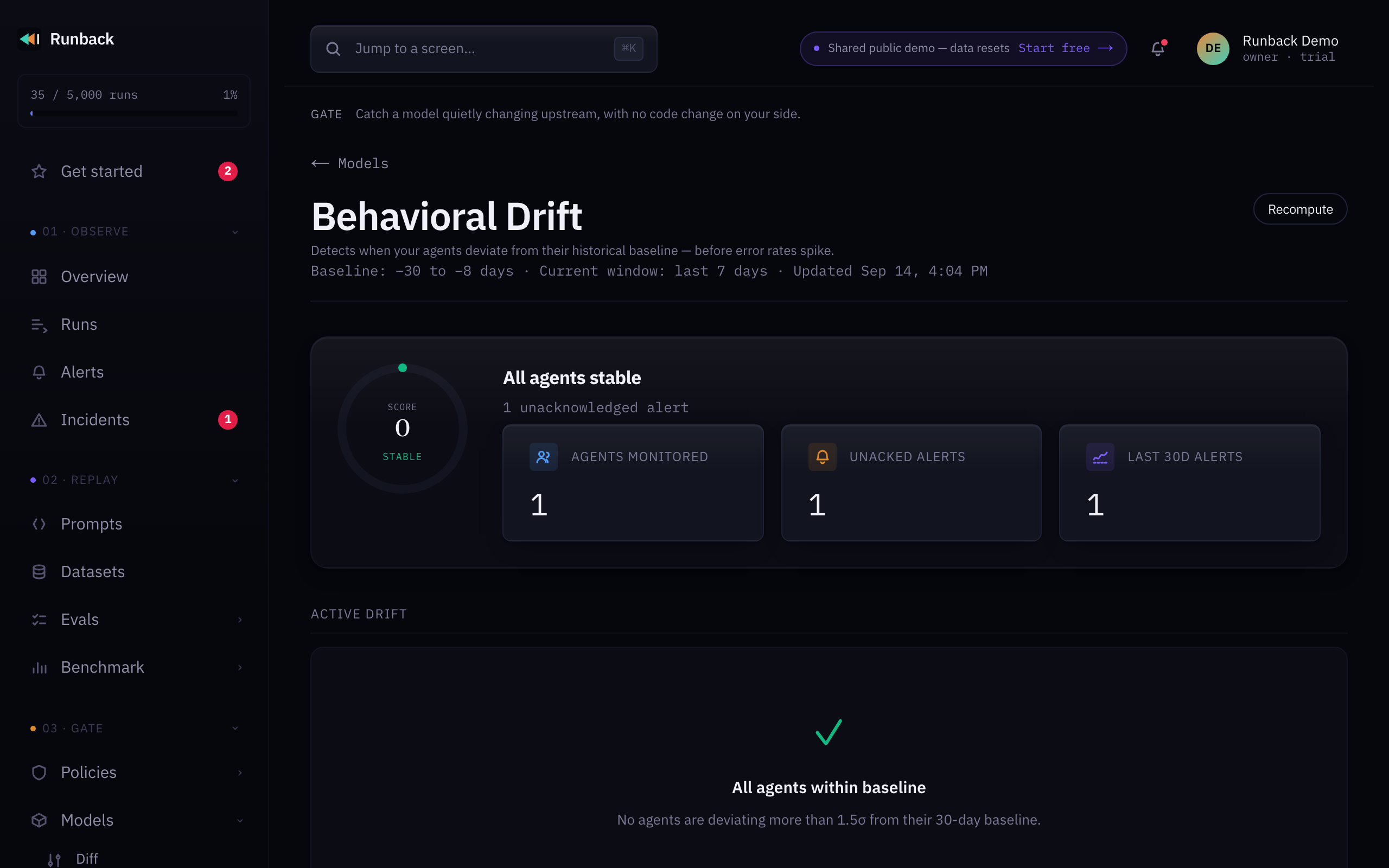
The same captured context from the run above, replayed against two other models before anyone ships an upgrade. Same input, same tools — different output means behaviour changed.
Week 1: wrap your riskiest agent, replay your first real failure instead of guessing at it. By month one, every incident auto-mines into a regression test, so the same bug can't silently come back after a prompt change.
See the rollout →Every decision sealed in a tamper-evident chain, self-hosted in your own VPC. APRA CPS 230, EU AI Act Art. 12, NIST AI RMF — one record, reviewed by your risk committee, not three separate log exports.
Enterprise & compliance →Every AI session captured and sealed the moment it happens. Replay the exact session for a partner, a court, or a regulator. Policy gates flag a high-risk output before it reaches a client.
Governance for legal →Policy gates run before the call, not after the incident report. The block is sealed into the record automatically — so "we prevented it" is something you can show, not something you have to be believed about.
How it works →The rollout from a single wrapped agent to a governed fleet — the journey a CTO can hand to their own team.